How the state invited sabotage to our streets
From high-society Tory garden parties to street-level arson attacks, the Kremlin is running a cold war on trust itself. It’s time for a full public inquiry.

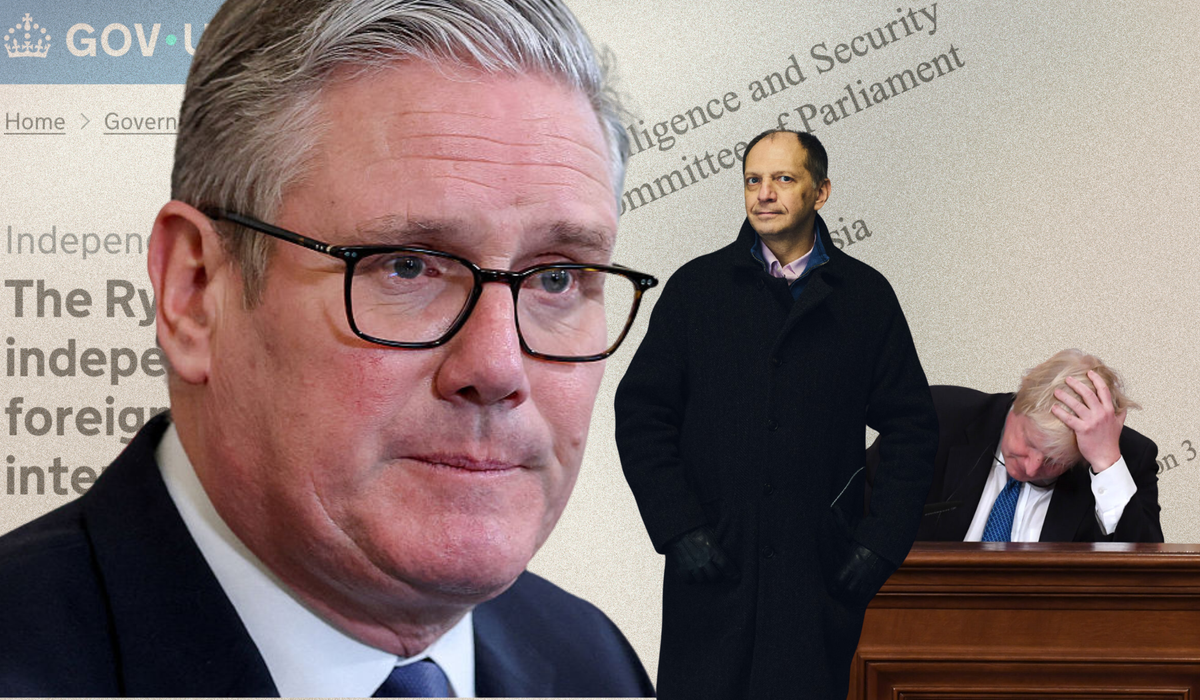
A 2012 political garden party filled with vodka and Tory MPs and a petrol bomb outside the Prime Minister’s house look like entirely disconnected events. In reality, they are the opening move and the latest escalation of the exact same campaign.
Following a six-week trial at the Old Bailey, 22-year-old Ukrainian builder Roman Lavrynovych was convicted of conspiring to commit arson attacks on properties linked to the Prime Minister. The court treated it as a simple, isolated criminal plot, with the judge blocking evidence of foreign state involvement as “wholly irrelevant”.
But a BBC investigation, aided by research provided by HOPE not hate, has traced the plot back to an information warfare school in Moscow. The handler, 23-year-old Evgeny Lyukshin, was an active intelligence operative.
And his tutor? A man named Sergey Nalobin.
If that name rings a bell, it’s because you’ve heard it on our podcast, Sergei & the Westminster Spy Ring. Nalobin is the former First Secretary of the Russian embassy in London. He is also the man who, over a decade ago, tried to buy his way into the Conservative Party, and whom the British establishment actively chose to ignore.
👉 Listen to Sergei & the Westminster Spy Ring here (or wherever you get your podcasts).
In this edition of the Citizens Understand, we look behind the smoke of the arson attacks, mapping a decade of political complacency and institutional failure that allowed a foreign state to strike the heart of British democracy. It leaves us with one burning question: why is the state still running from the truth?
🤷♀️ Who is Sergey Nalobin?
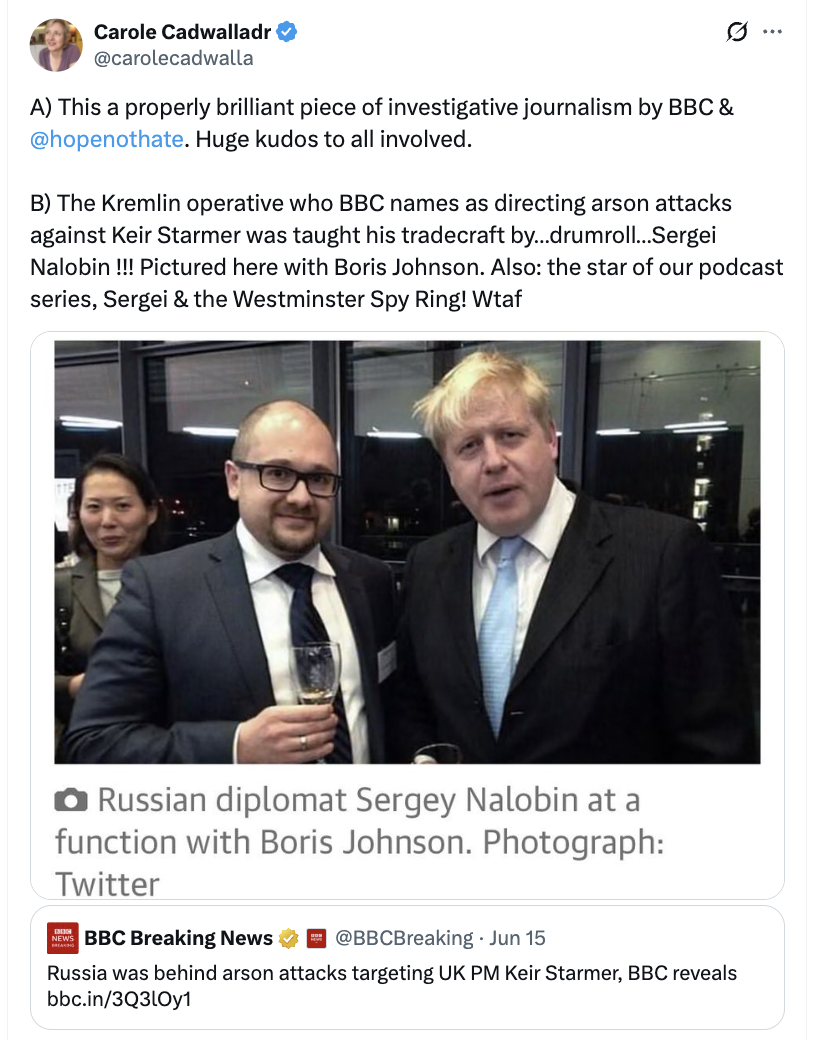
For those of us who spent the last decade warning that Putin was actively targeting the foundations of British democracy, the names surfacing in connection with the Keir Starmer arson attacks trigger a grim sense of déjà vu.
Lyukshin is a graduate of the Moscow State Institute of International Relations, a Russian state academy where he was trained in information warfare and how to undermine democratic security by Sergey Nalobin - the diplomat who ran Russia’s political influence operations in London over a decade ago.
To the Russian state, Nalobin is a master of “active measures,” the KGB’s term for state-sponsored subversion. He is the son of Nikolai Nalobin, a high-ranking KGB general and former boss of murdered dissident Alexander Litvinenko.
But to whistleblower Sergei Cristo, a Russian-born Conservative activist, Nalobin’s real agenda became glaringly clear in the summer of 2011. Cristo recognised a coordinated, covert attempt by the Russian diplomat to circumvent electoral laws and funnel illicit foreign wealth directly into the Conservative Party. “We have Russian companies that would like to contribute to the Conservative party,” Nalobin told him.
Recognising this was a criminal offence, Cristo flagged it to the MI5. He even offered to run a sting operation to catch the diplomat in the act, but the MI5 refused to act and Nalobin remained in London.
He went straight to work. By 2012, Nabolin helped launch the “Conservative Friends of Russia,” a sophisticated political lobbying and recruitment group run by Russian intelligence. When journalist Luke Harding exposed the group later that year, forcing its public collapse, the British government still chose to look the other way.
Years of inaction followed until Parliament’s Intelligence and Security Committee (ISC) finally published its long-delayed Russia Report in 2020. It confirmed, unsurprisingly, that British intelligence and security services had completely turned a blind eye to Russian political corruption and democratic subversion.
The committee urgently demanded a full, proper investigation into this political interference. Boris Johnson refused. And in the years since, successive Conservative and now Labour governments have done exactly the same.
🔎 Our take: Drug-dealing street talent repurposed for state sabotage
“Wagner’s mercenaries fight with guns; these recruits with petrol cans and burner phones.” - Clara Maguire, The Citizens
What the Starmer arson attack really exposes is how cheap and outsourced modern sabotage has become. Rather than highly trained foreign operatives, the Kremlin is conducting a corrosion campaign, a cold war on trust itself, by building a shadowy network of online provocation, misinformation and proxy warfare.
Evgeny Lyukshin ran this operation like a corporate gig. He used a fake online far-right front group, ‘Direct Action’, to sow division, and paid vulnerable, low-wage migrants to carry out increasingly dangerous physical attacks that went from anti-Muslim graffiti to firebombing homes.
We saw this exact pattern with the arson attack on a Leyton warehouse storing humanitarian aid for Ukraine. The people who set the fire weren’t foreign operatives; they were British teenagers and low-wage workers recruited online for a few thousand Euros.
The operation’s organiser, Dylan Earl, was a 20-something from Colchester who ran a small Telegram channel recycling pro-Kremlin propaganda. He took €5,000 in cryptocurrency from a Russian intelligence-linked account and hired a 23-year-old Gatwick Airport cleaner and three others in their early twenties to do the dirty work.
That ordinariness is the point. Ordinary work by ordinary people is harder to detect, easier to explain away and infinitely cheaper than fielding professional spies. By exploiting these deniable proxies, the Kremlin gets maximum disruption for minimal cost. It is a highly efficient strategy designed to fracture domestic stability and undermine the public’s sense of security, all while leaving the British legal system treating state-sponsored warfare as isolated, localised crimes.
✊ Countering the cover-up
“The best time to have had an inquiry was five years ago. The second best time is today.” - Carole Cadwalladr
For five years, we at The Citizens have pursued every available avenue in a relentless campaign to uncover the hostile influences targeting our political system.
The government’s Rycroft Review, published in March, finally admitted that a crisis exists but was dangerously narrow in its constraints. Designed to look only at external vulnerabilities, like closing future loopholes for corporate and crypto donations, it banned any scrutiny of the government’s own past failures and complicities.
By focusing on minor legislative adjustments, the political establishment is rearranging deck chairs while the PM’s house is on fire. Until we trace the line from the Westminster lobbying networks of 2010 to the proxy warfare on our streets today, our defences remain entirely exposed.
That is why our efforts continue. Following our landmark ECtHR ruling—which established a positive obligation for states to protect democratic processes from covert influence—we are now working with the APPG on Election Integrity to translate those principles into UK law through the Representation of the People Bill.
On Tuesday, 7 July, The Citizens will convene two expert witness hearings in Westminster to build the definitive case for a full public inquiry into Russian interference. Bringing together legal experts, journalists and intelligence specialists, we will confront the questions the government is refusing to ask.
We can’t make it a public event (sadly) but will be recording the evidence and publishing a full report. Stay tuned.
See you next time,
Team Citizens
About Citizens Understand: In an era where technology is reshaping democracy faster than laws can keep up and power is increasingly exercised through platforms, Citizens Understand exists to cut through misinformation and make complex systems legible. If there’s something you’d like to understand, email lillian@the-citizens.com.