
You Can’t Drink Data - Leeds residents protest Microsoft Data Centre
Hundreds gathered in Leeds last weekend to protest plans for three hyperscale data centres at Skelton Grange, raising concerns over water, energy, climate impacts, local democracy and the growing role of multinational tech companies in Britain’s digital infrastructure.

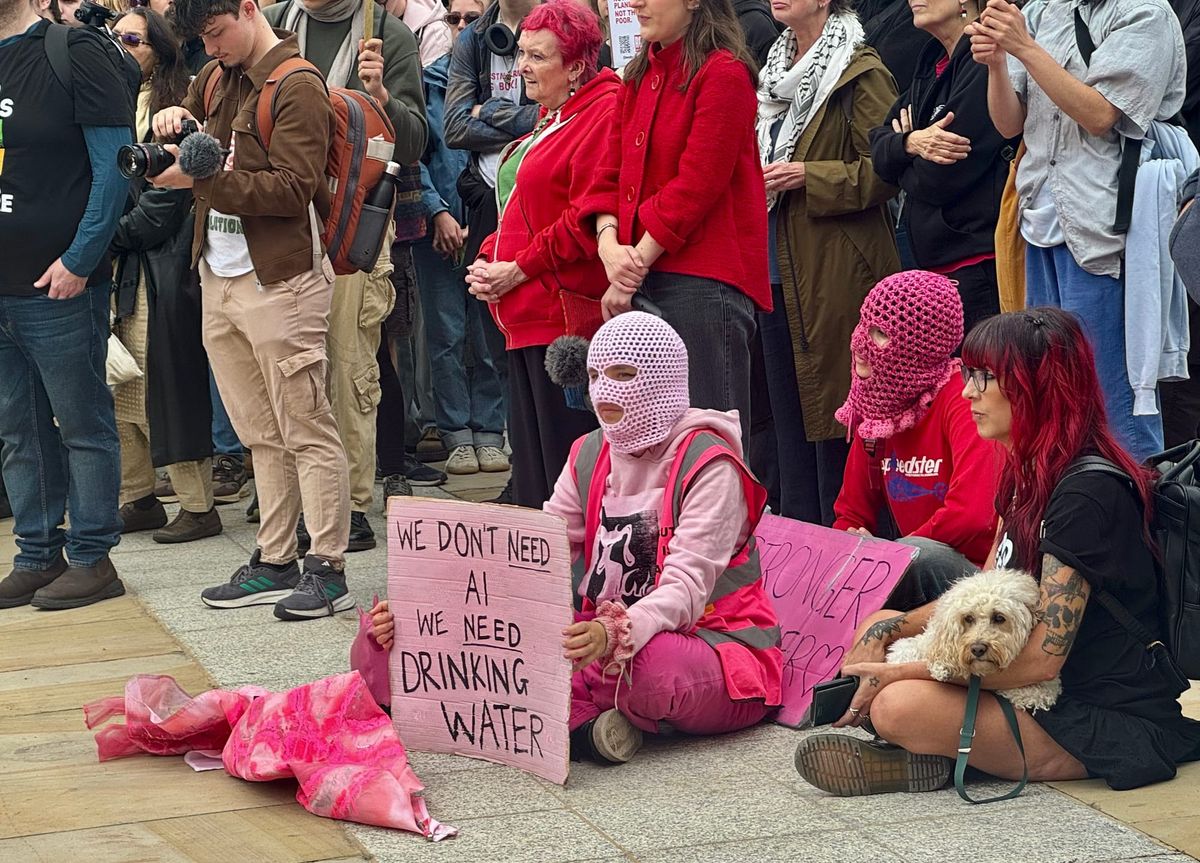
On 12th September, hundreds gathered for the first ‘National Data Centre Day’ in Millennium Square, organised by action group No Leeds Data Centre, which says it lost count of attendees ‘after the first 300 people showed up.
The Citizens attended the event to hear the concerns of residents and to continue to report on the backlash to the new, in this case US-owned (Microsoft) campus of three data centres buildings being constructed in the area.
Speakers at the event included Labour’s MP for East Leeds Richard Burgon, councillors Joe Ingram and Eden Hills from Leeds Green Party, as well as speakers from Pull the Plug, Greenpeace, Stop Burning Trees (which campaigns against Drax), Workers Power, Stand Up To Racism, and a host of local residents.
Protestors could be seen holding signs saying ‘We need energy security not data centres’, ‘you can’t drink data’, and ‘No To Mega Data Centres’. The groups’ opposition focuses on the incoming construction of 3 Hyperscale AI Data Centres at the former Skelton Grange power station site in Stourton.
Speaking to The Citizens, organiser of the campaign, Lianne Marie Mease, outlined some of the concerns of local residents about the project, which has already been given planning permission by Leeds City Council.
Please consider supporting our work each month or if a one off donation
“Due consideration has not been put into this”
She described that they oppose the project on “both a local and national level”, because “due consideration has not been put into this data centre or in fact any of the data centres currently being objected to around the UK”.
“On a national level, the UK government is on a quest for data sovereignty but they don’t know how to go about and get it. They seem to think that they get data sovereignty by allowing multinational foreign corporations to come in and process their data here. What we need is investment in UK firms and to have control over our own data.”
As previously reported in The Eye, many of the new data centres due to be built in the next five years will be privately funded by the likes of Microsoft, Google, Nvidia, and other firms located outside of the UK, with the UK’s largest data infrastructure dominated by overseas capital from companies like Vantage - backed by the Singaporean Sovereign Wealth Fund, with US asset managers also backing many initiatives.
The campaign argues that this raises broader questions about who owns and controls the infrastructure underpinning the UK’s increasingly digital economy.
How Big is Too Big?
Hyperscaling is also a complaint of the protestors, which Lianne Marie argues could be “much, much smaller”. One item that the protest hopes to address is the lack of local pushback to the plans of “corporations who might want to build them very big, for their very big profits”. Instead, No Leeds Data Centre argues that we can “approve them if we need to, and make them smaller and more suitable for the locations that they’re in”.
Also cited is a point that has been raised time and time again by campaigners, that sound and noise pollution, as well as massive environmental impact and a drain on resources, play a huge part of people’s concerns over the plans.
The group’s page states that, if constructed, it would be ‘by far the single biggest carbon emitter in Leeds’, and that: ‘Microsoft aim to use an air cooling system which only requires water when outside temperatures exceed 29.4°C. The water requirement is more than Yorkshire Water can currently provide and only 40% of the demand could be met by the proposed rainwater harvesting.’
‘As the climate catastrophe accelerates, so does the ambient temperature so the closer we get to drought, the more water the datacentre will need to guzzle up. This development would be situated in one of the densest Heat Island zones in Leeds’.
However, despite the pushback, West Yorkshire Tracy Brabin, Lianne Marie claims “apparently thinks that it has 100% local support when it clearly does not”, and that the hopes of the campaign, in conversations with the mayor and her subsequent conversations with Microsoft, are to encourage her to push back against the company and build something in-line with Leeds net zero targets.
We don’t have a say
The government recently announced, days after another major protest opposing a £13bn data centre and battery energy storage project in North Devon, that it was scrapping mandatory public consultation for major infrastructure projects, including data centres, leaving many feeling disenfranchised.
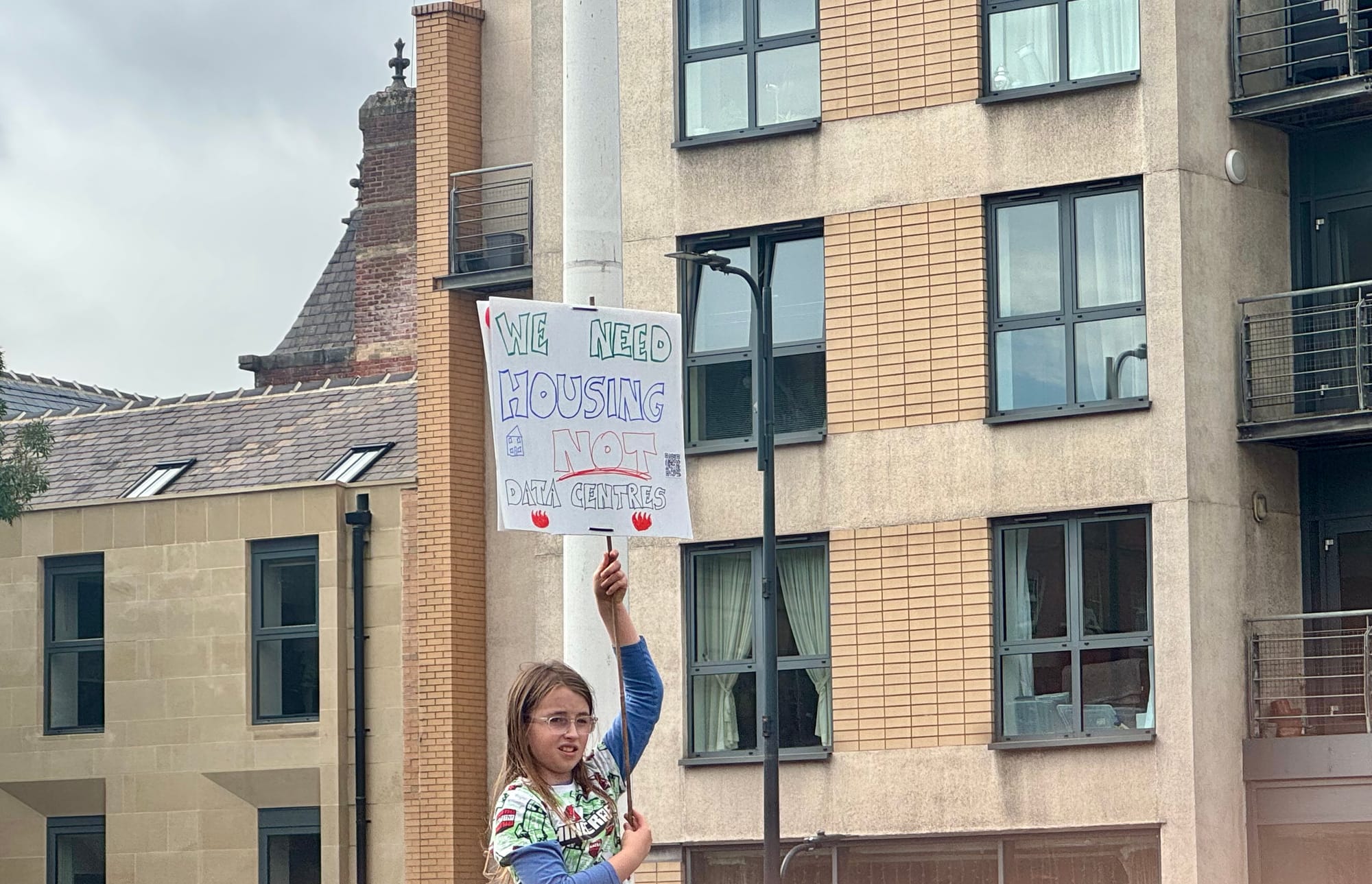
Speaking at the event was Mia, aged nine, and her mother Sally, former residents of the boat moorings at Skelton where the sites are being built, and objected about the construction for environmental reasons.
Mia said that “I live on a boat in Leeds. I want my future to be bright and fulfilling for the climate and nature around me. When they build this data centre, we’ve got to think about the impact this will have on our climate.”
“Growing up, I’ve been very aware of our climate and Earth. It’s our future that it will impact on, and we never get asked about how we feel about AI.”
Tom, representing campaign organisation Pull the Plug, said that we should not only be tough on data centres, “but also tough on the causes of data centres. It’s not inevitable. We’re being tricked into making it inevitable by having AI forced into everything. We must resist.
“I call on you to find alternatives, to think: do I have to use this? That is one of your biggest powers.”
MP Richard Burgon has said that as soon as Parliament returns from recess, that he has “put down a parliamentary motion with a single important demand - that the government introduces a national moratorium on the building of all new hyperscale data centres.”
A national fight over data centres
As well as the nation-wide opposition actions to rapid AI data centre expansion for environmental and resource-based reasons, a new report from think tank Verdant has also drawn into question its viability for job creation, one of the key selling points for the government’s plans.
Verdant estimates that planned data centres will create only around a quarter of the jobs projected by the industry, a gap that also reflects current data centre employment (4,400 direct jobs) versus techUK’s estimates of 24,300 jobs. The government has rejected the findings of the report, however, claiming that it focuses only on in-facility roles, rather than the wider job creation in the data centre supply chain.
At time of writing, nearly 44,000 people have now signed a petition opposing Microsoft’s proposed data centre site in Stourton, which cites the ‘risk to the health and wellbeing of local residents, and the surrounding environment’. The ‘No Leeds Data Centre’ instagram page has over 6,350 followers.
For campaigners, the question is not simply whether Britain needs more computing power.
It is who builds it, who controls it, who pays for the resources it consumes and who gets to decide how much of it is built in the first place.