Britain still hasn't looked
A democracy that won’t investigate its own weaknesses - is a weak democracy. Let’s make sure Parliament doesn’t look away again.

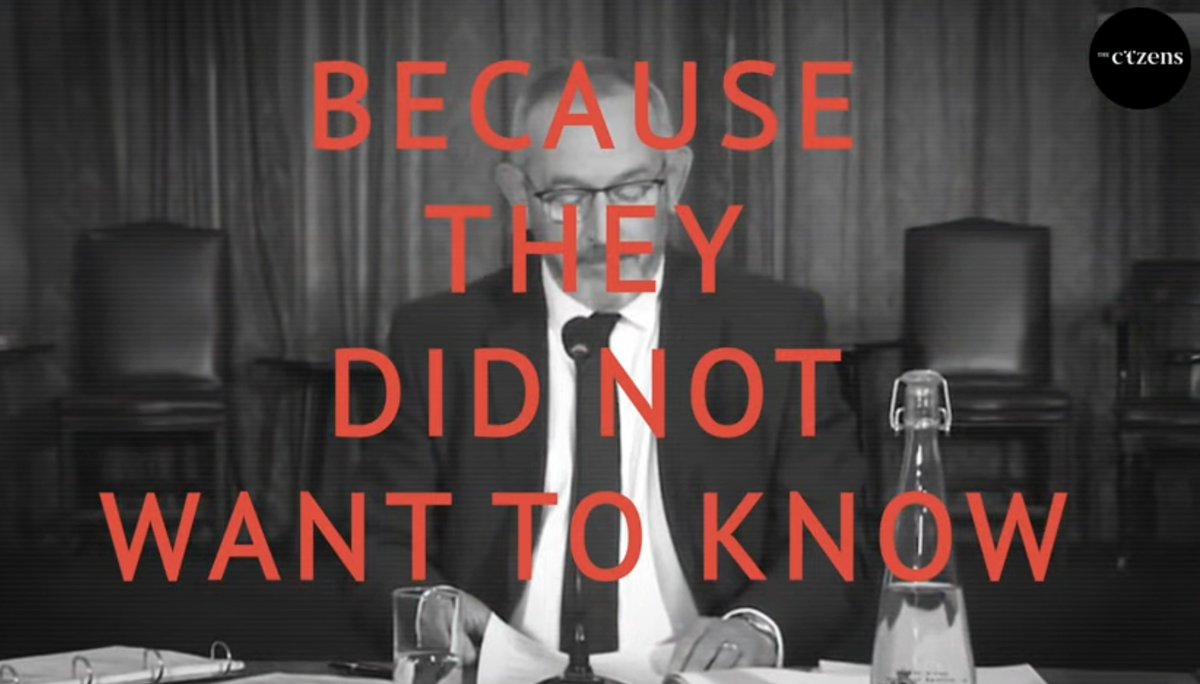
For years, the UK has avoided one basic question: how have foreign powers, or bad actors interfered with our democracy?
This week, MPs and experts met for a private briefing ahead of the parliamentary debate on Russian interference scheduled for Monday 9 February.
The briefing was chaired by Alex Sobel MP and brought together people who have spent years inside this issue from different angles: former Attorney General Dominic Grieve, investigative journalist and Citizens founder Carole Cadwalladr, former intelligence officer Christopher Steele, anti-corruption campaigner Susan Hawley and whistleblower Sergei Cristo.
“When you don't have transparency it makes it easier for far right populists to take control.” Whistleblower Sergei Cristo on why we need a full inquiry on Russian interference 👇
— The Citizens (@the-citizens.bsky.social) 2026-02-03T17:33:20.972Z
The briefing laid out, in stark terms, how Britain has failed, repeatedly, to examine how its democracy is being attacked and why that failure leaves us dangerously exposed.
With a parliamentary debate imminent, this is a moment where public pressure can still change the outcome. What follows is a summary of the key points discussed at the briefing, and a simple way you can push for the full inquiry this issue demands.
Subscribe to the Citizens for explainers that makes sense of power and campaigns that turn public pressure into change.
Why a full inquiry is still necessary
Over 114,000 UK voters signed a petition calling for a full inquiry because “those who do not know their history are condemned to repeat it,” one speaker said.
That public demand reflects a wider collapse in trust.
Confidence in democracy is at historic lows, with growing numbers of voters believing elections no longer reliably reflect their well.
A core reason, fundamental to the need for this inquiry, is that foreign interference distorts both the information people rely on and the level playing field democracy depends on.
As one speaker put it, if we want to be able to say that future elections will be free and fair, we need a “proper understanding of what happened in the past”.
The 2020 Russia Report warned that hostile-state interference had become “the new normal” and identified credible attempts by the Kremlin to influence UK politics. Crucially, the Intelligence and Security Committee explicitly called for further investigation. None followed.
What we already know - and still haven’t examined
Russia’s role in British political life was described as utterly disruptive, malign and ongoing - with evidence of interference as “overwhelmingly clear” by 2017-2019.
But the roots go back further. Speakers pointed to the period between 2010 and 2014, when early reports of attempted Russian political financing were allegedly ignored by UK authorities. That failure to act, it was argued, weakened deterrence at a critical moment.
With no meaningful enforcement in place, Russian-linked money is believed to have entered British politics through a web of proxies, commercial interests and legal loopholes - from anonymous donations to crypto-assets and para-political organisations.
Crucially, the briefing stressed that Russian interference does not operate on a single track. It functions across multiple, reinforcing layers: covert political funding, corruptive influence, cyber operations, disinformation campaigns and hacking.
“If you put everything together, you realise the cumulative effect is much more magnified and serious,” one speaker said.
Why the government response is not enough
Successive governments insist the threat is under control. They point to the National Security Act and other reforms.
At the briefing, that reassurance was dismantled - measures described as remaining “largely on paper”.
There has been no systematic investigation into failures around Brexit or the 2019 election. No real-time vetting of political donations. No clear tasking of intelligence agencies to investigate political interference. Little coordination between security services, police and the Electoral Commission.
The Intelligence and Security Committee concluded that agencies actively avoided looking into interference despite ample evidence. Political parties were left to police themselves on donations.
The Rycroft Review won’t fix this
Labour now tells us the situation is in hand. The Rycroft Review - billed as an “urgent” inquiry into foreign financial interference following Gill’s sentencing - is presented as sufficient.
Speakers raised serious concerns about the review’s scope and credibility. It has no clear national security expertise and explicitly excludes large-scale Russian interference around Brexit. With the report expected within weeks, several warned it risks becoming a “whitewash enquiry”.
A full public inquiry would be fundamentally different. It would operate transparently, compel evidence and meet the standard of accountability that voters expect in any functioning democracy.
Without it, voters are still “grappling in the dark”.
What happens next is up to us
Last year, we took our case to the European Court of Human Rights. The Court confirmed something crucial: large-scale disinformation and foreign interference are real threats to democratic life, and states have a duty to address them.
But it also showed us the limits of law. An international court will not force the UK to hold a public inquiry into its own democracy.
That responsibility now falls squarely to politics - and to us - which is why this moment matters.
🗣️ Tell your MP this debate matters 🗣️
Public inquiries are one of the last mechanisms capable of dragging the truth out of institutions that would otherwise bury it.
On Monday 9th February, Parliament will debate a petition calling for a public inquiry into Russian influence on UK politics and democracy.
Between now and then, MPs need to hear from constituents—loudly and clearly—that this cannot be ignored.
So we’re asking you to do one thing: Email your MP and ask them to be present at the debate on 9 February.
We’ve made this simple.
Copy the message below, paste into an email to your MP, add your name and postcode, and hit send.
🔎 Find your MP: https://members.parliament.uk/FindYourMP
Email Subject: Please attend the Russia interference debate (9 Feb)
Dear [MP’s name],
I am writing as your constituent to ask you to engage with the upcoming debate on Russian interference in UK politics on Monday 9 February.
The Intelligence and Security Committee warned years ago that hostile-state interference had become “the new normal”, yet no full public inquiry ever followed. Recent developments have only underlined how real and unresolved this threat remains.
I hope you, or a member of your office, will take this issue seriously and attend the debate.
Best wishes,
[Your name]
[Your postcode]
In solidarity,
The Citizens