Russian Inference, Brexit - our democratic wound
And why only a full reckoning will heal it

Last week there was a petition debate on Russian interference into UK elections. Thanks to all of you that emailed your MP’s asking them to go and also to attend our briefing the week before. Write up of that here in case you missed it.
Across parties MPs acknowledged that Russian influence in British democracy is not a historical footnote but an ongoing and unresolved crisis. It’s never been examined, never settled, so it continues to warp our political reality. Then on Thursday the Representation of the People Bill dropped (which stalled me getting this post out). Spoiler alert … it’s not good enough! Nor are the other measures presented at the debate - I’ll get to that later.
For years, as attention shifted from Russia toward the growing power of Big Tech, the underlying pattern never disappeared: disinformation, algorithmic amplification and extremist narratives moving from fringe to mainstream, sustained by invisible money. What remained hidden was the nature of this pattern - something the Epstein Files are starting to shed light on.
For me the Epstein files don’t feel like a new story - despite the endless breaking revelations - what they do is place so much of what has been happening to our democracy in the last 20 years into the same sphere of power. I’m not saying it’s a single coordinated conspiracy, but the files make clear that there are recurring overlaps between financial opacity, political influence, technological power and narrative manipulation. The same actors, the same methods, the same structural vulnerabilities appear again and again. The question is no longer whether these domains intersect - that much now is clear - but rather how deep do the intersections run? Bannon, Thiel, Mandelson… need I go on?
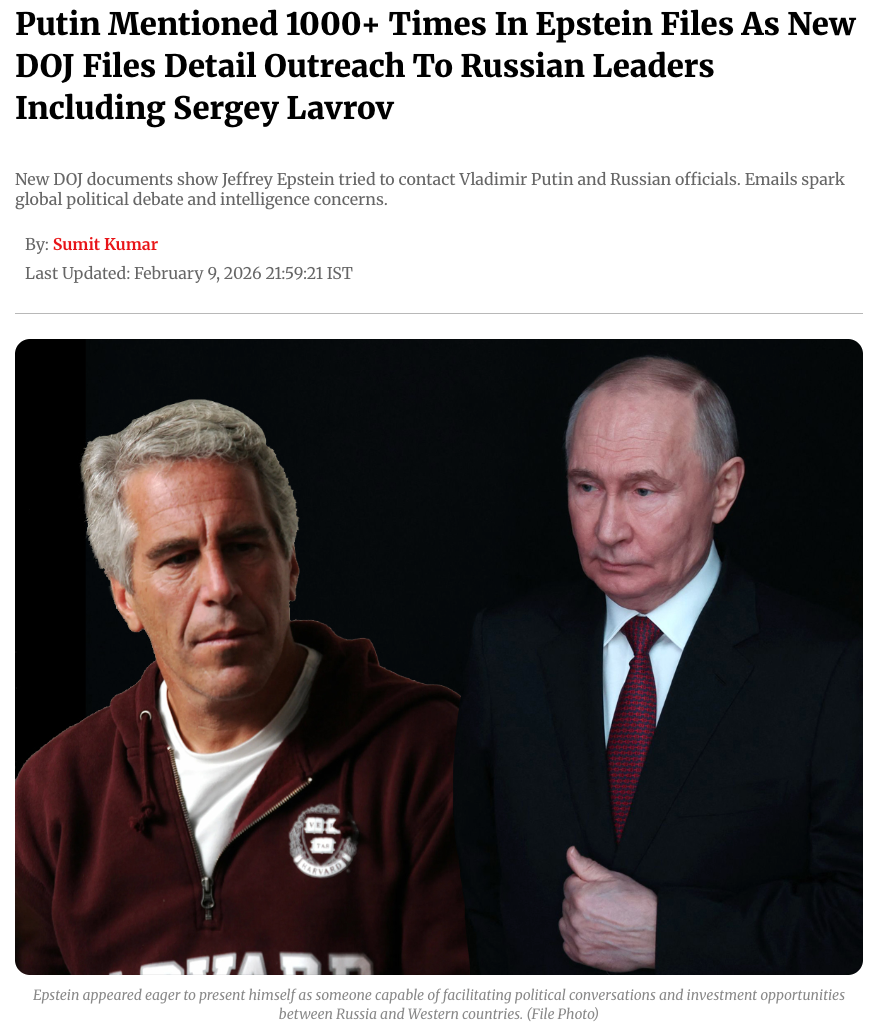
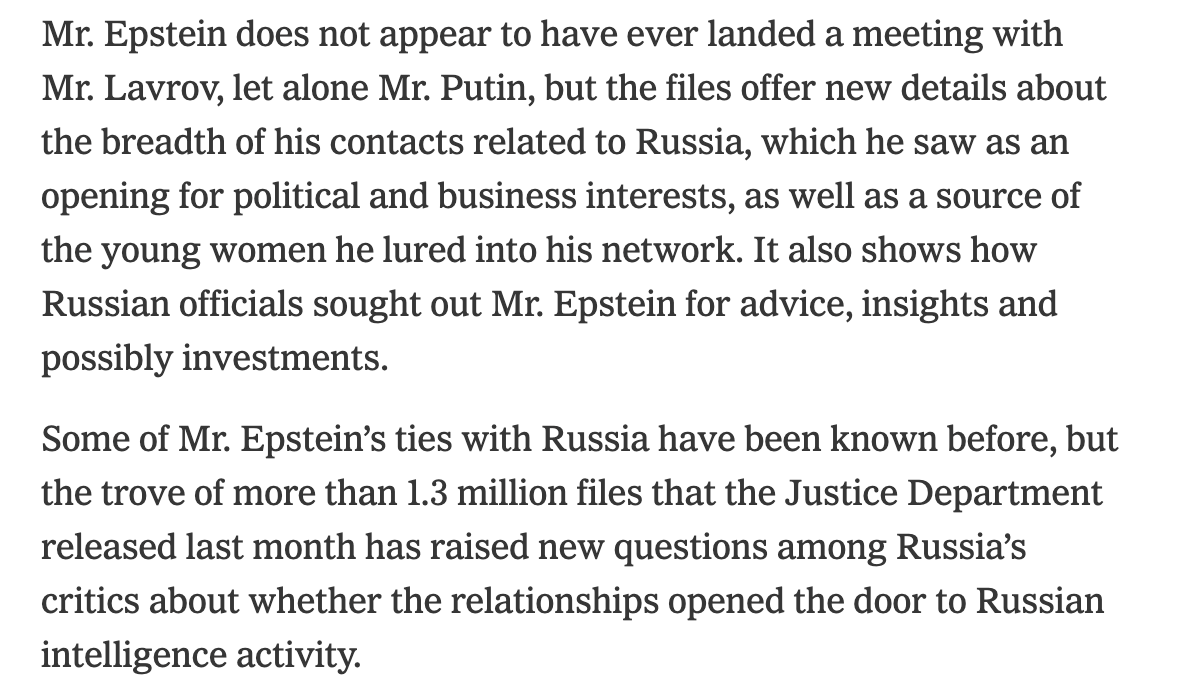
And the Russia of it all is only just unravelling… the New York Times report that Epstein actively cultivated relationships with Russian officials and sought access to the Kremlin. They reveal his repeated attempts to arrange meetings with Vladimir Putin (impressive level of self-confidence) and connect with figures linked to Russian state and intelligence circles. Epstein maintained networks with Russian elites and former officials connected to Moscow.
What once looked like separate domains don’t feel as separate. The connective tissue is the prevailing ideology of exploitation. The exploitation of young women and girls. The exploitation of political access and elite networks. The exploitation of financial systems, loopholes and workarounds. The exploitation of our information environment, where truth is fragmented until reality itself feels unstable.
Green MP Dr Ellie Chowns hit the nail on the head during Monday’s debate - she described a “sinister web” - an interconnected sphere in which crypto-finance, far-right political networks and Russia-linked influence operations overlap and intersect with British political life.
Watch this! (She also asked a banging question about Palantir this week - yes Dr Chowns)!
And yet - the Government’s response does not yet match the scale of the democratic question being asked. There was a clear expectation that the Representation of the People Bill would address how we defend democracy in an age of hybrid, digital and cognitive warfare. It does not… despite calls from MP’s and formal submissions to Parliament warning that UK electoral law remains unfit for purpose. Here is Mr Alex Sobel - chair of the Elections APPG stating what the Bill needs to do.
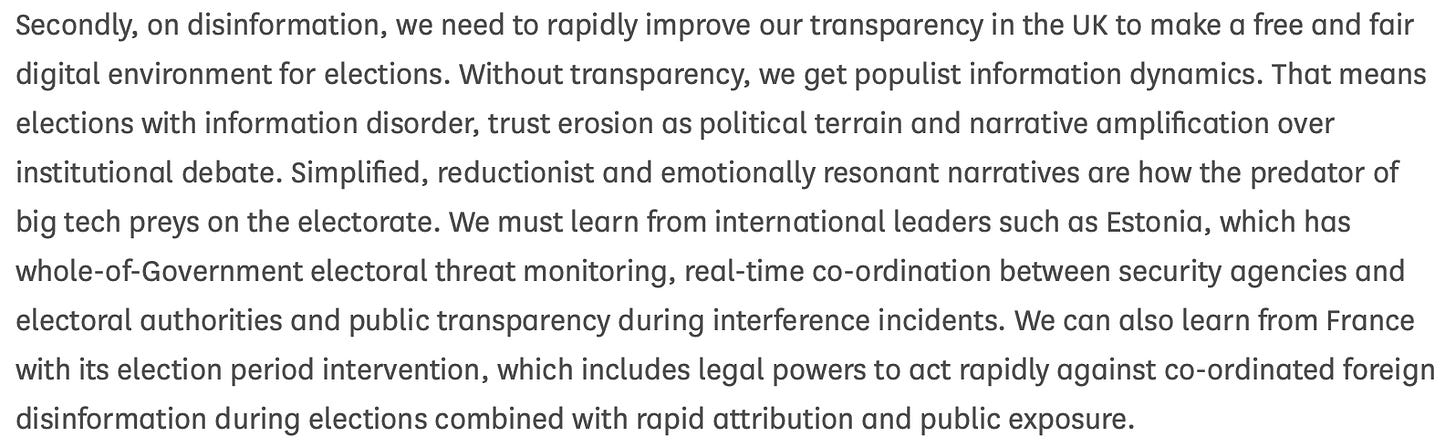
What has emerged in the Bill is significantly narrower, focused largely on political finance, foreign money and electoral mechanics - all necessary, but the central battleground of contemporary interference - the information environment itself - is still not addressed in law.
Back in 2020, when we started our legal action, Russian disinformation was dismissed by the Government, and in the High Court it was even worse…

A shock jock?!? Then in 2025 the European Court of Human Rights recognised a critical principle “European states have a positive obligation to safeguard citizens from disinformation and covert influence by foreign powers”.
And yet… Ben Lake Plaid Cymru MP for Ceredigion Preseli in last weeks debate…

I’m not blaming Ben Lake for this but, this isn’t good enough but it’s 10 years on!!
Measured against that standard, our current response - the narrow Rycroft Review, three months long and precluding Brexit altogether, limited transparency, and the Representation of the People Bill - barely confront the realities of modern information warfare and feel profoundly inadequate.
At the close of the debate, the Security Minister repeated a familiar patter - some information cannot be made public for reasons of national security. That is understood. No responsible democracy exposes its intelligence capabilities lightly. But there is a deeper democratic principle that cannot be avoided. Trust cannot be rebuilt in darkness. The ‘nothing here to see’ words don’t bring us comfort, because we’ve been told that for years - told we must trust - and time and time again let down.
This is why the announcement of three million pounds for media literacy was met with silence.. Compared to the scale of the threat described across the chamber - a form of hybrid warfare aimed at perception, cognition and democratic cohesion… £3m quid … over 3 years - seriously?
“I am pleased to announce today that the Government will invest £3 million over the next three years to support the higher education sector to strengthen its resilience. That will include setting up a new foreign interference reporting route for UK universities and co-designing best practice guidance that will help universities to make proportionate, risk-based decisions on the threats to which they are exposed”
Several MPs framed Russian strategy as a long-term project of weakening democratic states through division, distrust and institutional erosion. We’ve known this for a long time. So the UK government’s approach - £3m here and a three month review there - and everything else inscrutable - simply doesn’t cut it.
And beneath all of this lies real injury against the British people. If foreign influence touched the most consequential democratic decision in modern British history, then the public is entitled to know the full truth. Not fragments and assurances delivered from behind the National Security line. The full truth.
Our democracy and elections are under attack by a now not so shadowy ecosystem plainly seeking to destroy it. Parliament has acknowledged the seriousness of the issue. The debate ended in unanimity. Recognition exists - but this is only the beginning.
We will be working hard pushing for amendments to the Bill - tell us what you want to see it and more very soon.