The £100m gamble
Millions in public money are going into home-grown AI, with few guarantees over what Britain gets back

Welcome to the ninth edition of The Eye—our weekly guide to the shifting relationship between Big Tech and the state.
This week: The government’s latest plans to break with Big Tech, record AI spending and what “sovereign” actually means.
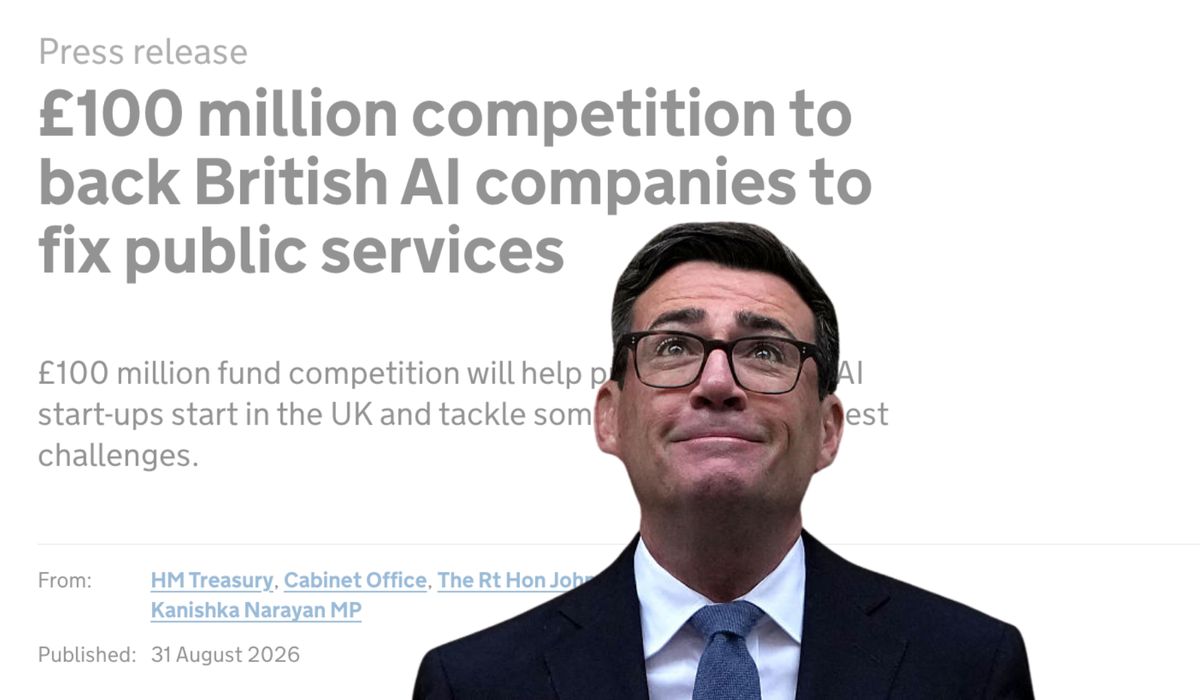
The government opened the first competitions a new £100m procurement scheme on Wednesday, designed to give domestic start-ups a route into public sector contracts, tackle “some of society’s biggest challenges” and compete with Big Tech.
The announcement, given by Chancellor John Healy MP, states its aim is to boost British companies to help with a range of tasks from NHS productivity and national security to cyber security and computing infrastructure.
The scheme is the latest development under the £500m Sovereign AI Fund launched under Keir Starmer in April. Though, as with prior innovations in the space so far, based on previous announcements, a key question will remain: how sovereign is sovereign?
FOI disclosures related to the Sovereign AI Fund reveal that more than one in three of the ‘sovereign’ AI firms were ultimately owned by US parent companies. One was itself US-based, with only an R&D hub in London.
The department then in charge, DSIT, also confirmed that no binding equity conditions were attached to the agreements - including nothing on UK jobs, tax residency, or location of intellectual property - and it would be highly unlikely for the UK to retrieve anything back if one of the firms were to relocate or get bought out by a non-British company.
Burnham’s government has so far indicated a greater emphasis on “buying British”, including a shift towards home-grown AI, it still remains to be seen how and to what extent this will be achieved.
As previously reported in The Eye, Europe is already taking steps to reduce its reliance on American technology. Burnham has similarly signalled a cooler, more pragmatic approach to UK-US relations.
Research suggests that AI is now used in every government department, up from 81% a year ago. The study, produced by Mattison Public Relations, found that only 30% of departments had issued instructions on how to use AI to improve productivity and quality.
Meanwhile, tracking from Tussell found that 2026 is already the biggest year on record for AI spend, with the number of contracts also set to exceed the record set in 2025. Of the total £5 billion spent on AI-related contracts during 2018-2016, only around 49% (£2.19 billion) went to UK-based suppliers, with over £2.27 billion being awarded to American companies.
Microsoft, Palantir and UK-based KPMG were the three largest beneficiaries. Four of the top ten suppliers were UK-based, with five of the others headquartered in the US.
The Science, Innovation and Technology Select Committee previously warned that this dependence leaves the UK seriously exposed to foreign states cutting off access to critical systems, in a world where the country “may not be able to count on its allies”.
It said the government “needs a realistic plan to develop sovereign capabilities in critical areas, or risk having its access cut off at the whim of its partners” - citing the export ban placed by the Trump administration on the latest Anthropic models.
Notably, under the new scheme, private firms will retain the intellectual property they create, while the government offers upfront public funding to design, test and demonstrate potential uses within the public sector.
As reported by the FT, the Sovereign AI fund also does not require start-ups to remain in Britain as they grow, raising doubts about how much of the wealth generated from public investment will ultimately remain in the UK.
Both the Cabinet Office and Department for Business, Innovation, Science and Trade were approached multiple times for an on-record comment, but declined to confirm whether companies had to be both UK-based and UK owned, as opposed to just having subsidiaries and hubs in this country while being based abroad.
They also failed to put forward a case for funding private companies that retain IP over pursuing open-sourced, interoperable models, or confirm how much the £100 million represents in terms of wider government spending on new AI initiatives.
Under new rules, the government has previously said suppliers can receive credit for creating local jobs that pay above the legal minimum, with annual progress reports made available to the public. But it remains unclear what, if any, similar conditions will apply to the government’s new AI investment.
Dame Chi Onwurah, chair of the Science, Innovation and Technology Committee, told The Citizens that while it was “great to hear” the government intends to invest in British AI, “we need far more clarity on what exactly the government’s strategy for technology sovereignty is, and where we are aiming for sovereign capabilities in areas like AI”.
Onwurah also pointed to the importance of open-source models, adding that the government needs to provide “a clearer understanding soon of its plans to achieve tech sovereignty, and ultimately help secure the UK’s security”.
The test, therefore, is not whether the government buys from companies with a British office, but whether public investment leaves Britain with lasting control over its technology, intellectual property and critical infrastructure.
Thanks for reading! We are developing this as we go, and we want to build it with you. Tell us what’s working and what’s missing below.
Max
About The Eye: In an era where Silicon Valley is rewriting the rules of governance and unaccountable tech companies are capturing our public services from the inside out, The Eye exists to follow the power, connect the dots and reveal how technology is reshaping our state.