
Trump’s AI theatre distracts from regulatory failure on both sides of the Atlantic
As Trump rebrands AI and leaves tech firms to police themselves, Britain is relying on a patchwork of existing laws - despite its ambitions to lead the world

Welcome to the twelfth edition of The Eye—our weekly guide to the shifting relationship between Big Tech and the state.
This week: The UK’s approach to ‘superintelligence’, efforts to prevent human extinction and Trump’s politics of distraction.
While Prime Minister Andy Burnham has been busy on the world stage asserting the UK’s desire to emerge as a global leader on AI - whether through the plans to launch the new National Centre for Information Defence as announced at the UN General Assembly, or by leveraging the UK’s upcoming G20 presidency to craft a new global agreement on AI - his US counterpart remains stubbornly determined to allow tech companies to ineffectively police themselves and to put a more positive spin on the whole industry.
Less than two weeks after the White House issued an executive order to replace the term ‘artificial intelligence’ with ‘super intelligence’, and established a new taskforce for AI, the “Super Intelligence Force” (SIF), US President Trump upped the rhetorical ante, taking to Truth Social on 8 October to post: “The White House considers anyone that uses the term, ‘Artificial Intelligence,’ as opposed to the highly accepted new and more accurate term, ‘Super Intelligence,’ THE ENEMY!”.
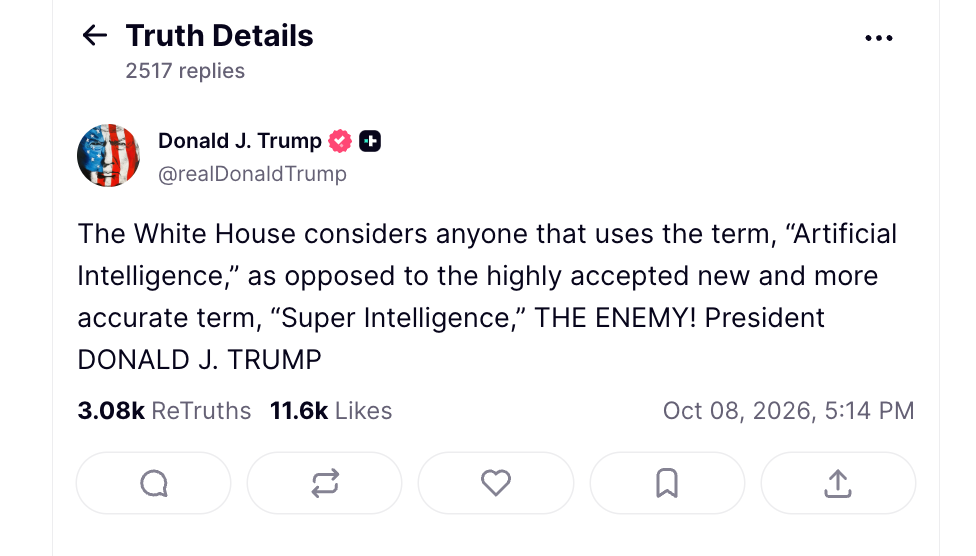
This rebranding attempt - and declaration of enmity - follows Trump signing a completely voluntary accord with tech executives stating that the firms will ‘self-police’ their AI development, signed by the CEOs of Google, Meta, OpenAI, Nvidia, Anthropic, and XAI and SpaceXAI (apparently soon to be SpaceXSI) boss Elon Musk.
Meanwhile, across the Atlantic, the UK’s own approach remains perhaps intentionally vague, cobbled together through a patchwork of existing and proposed legislation focused primarily on threats posed by foreign actors and a growth-over-risk approach that could have unintended consequences.
For example, the government recently rejected an emergency measure in the Cyber Security and Resilience (Network and Information Systems) Bill, currently at report stage in the House of Lords, per a ‘last resort’ amendment tabled by Liberal Democrat peer Lord Clement-Jones. The amendment would have created an effective kill switch intended to mitigate severe AI security or operational emergencies.
A number of relevant private members’ bills are also at various stages of consideration.
Also introduced by Clement-Jones, currently awaiting first reading in the House of Commons having started in the Lords, is the Public Authority Algorithmic and Automated Decision-Making Systems Bill, which if implemented would create new regulations around procurement of AI tools in the public sector.
Labour MP Alex Sobel has also recently tabled the Artificial Superintelligence Bill backed by a nonprofit group ‘working to prevent the risk of human extinction’ - ControlAI, in order to ‘prohibit the development, deployment and operation of artificial “superintelligence” systems’ and to ‘establish monitoring and control powers in respect of such systems’, which has passed its first reading in the House of Commons and is due for its second reading on 13 November.
Sobel also chairs the cross-party Committee on Human Rights (JCHR), which in a recent report identified human rights risks posed by artificial intelligence and found weaknesses in safeguards ’that the existing regulatory and legal framework are ill-equipped to prevent or respond to’.
Speaking on 9 September, Sobel said that “nowhere in the world, including the UK, has a current legislative and regulatory approach to AI that is fit for purpose”.
These newer iterations working their way through parliament could be seen as following on from attempts made by the Artificial Intelligence (Regulation) Bill, which was introduced during the 2023-24 parliamentary session but didn’t progress before its dissolution.
But the message from people at the highest reaches of government in charge of overseeing AI policy has been less firm, and seems to rely on a current mishmash of legislative provisions rather than the introduction of specific bills.
In response to the proposal of a “kill switch”, a cabinet office spokesperson said that they “cannot simply turn AI off” and that “blocking access to models in the UK would not prevent them being developed or misused elsewhere”.
After warnings about an existential threat to humanity from a former senior Anthropic employee, one of several recent security incidents within the industry, more than 70 MPs urged Burnham to back a ban on the creation of artificial superintelligence (ASI), but the new AI Minister, Kanishka Narayan, seems to have already rejected calls for a specific bill.
In late September, Narayan spoke at the Labour Party conference about an emphasis on building over regulating the technology, taking an embrace of AI-related industries in pursuit of growth, investment, and global leverage, focusing instead on building out the UK’s “sovereign capacity”.
While speaking at the Politico Pub fringe event, Narayan expressed that “at any point, if regulation or legislation is the mechanism to achieve those ends, I would be the first one in the queue to push for that”. But in response to concerns about potential superintelligence, Narayan seemed to imply that the UK didn’t need to legislate for that as it doesn’t have the capacity to build it, stating that he is not going to “do a bill for the sake of doing a bill”.
He said that the UK does not have the energy or data centre infrastructure to build ASI, and that under copyright laws “...It is currently illegal to develop a frontier large language model based on the transformer architecture, given the copyright position that we have”.
It seems that Narayan’s claims rely on the current existing legal framework being sufficient, and the governor of the Bank of England has also said that regulating AI is “not the right place to start,” but the view from MPs such as Sobel is that legislation is needed to ban as-yet non-existent ASI, echoing moves by the left in the US, where Senator Bernie Sanders has introduced a similar proposal.
Speaking to The Eye, Sobel said: “Chief executives at leading AI companies have estimated the risk of superintelligent AI causing human extinction at between 10% and 25%, yet many of these same companies continue to pursue a reckless race towards its development. With the risks to our national security being so grave, we cannot afford to sit back and hope for the best.
“If the UK Government wants to protect human life and retain its sovereignty, it must adopt my legislation to prohibit the development of superintelligent AI.”
Sobel continued, “I am pleased that the Government is starting to take this issue seriously. They are taking preventative measures including the testing of new models for safety prior to development. I would urge the Government to pursue international cooperation while implementing domestic safeguards. The UK is in a prime position to lead the way, as hosts of the G20 summit in 2027.”
The Ada Lovelace Institute has said that: “It’s clear that the current, voluntary approach to AI governance in the UK is no longer adequate.
“The question is not whether the UK should act, but what good AI regulation would look like.”
For his part, Burnham has previously said that “nothing is off the table” when it comes to imposing future roles on frontier AI companies, stressing the role that the UK’s AI Security Institute (AISI) is going to have. AI Minister Narayan has also said that the UK would consider regulating advanced models if voluntary agreements weren’t adequate, though with repeated breakouts from test environments from major players like OpenAI and Anthropic, it seems less and less as if self-regulation is working.
Whether the UK’s current patchwork approach to AI or ‘superintelligence’ is by default or design, if the country has any hopes of emerging as a global AI leader per Burnham’s ambitions, a more clearly defined and less piecemeal domestic approach is needed sooner rather than later. This must include concrete policy positioning and a solid legislative framework at the core rather than rhetorical distraction à la Trump.
Thanks for reading! We are developing this as we go, and we want to build it with you. Tell us what’s working and what’s missing below.
About The Eye: In an era where Silicon Valley is rewriting the rules of governance and unaccountable tech companies are capturing our public services from the inside out, The Eye exists to follow the power, connect the dots and reveal how technology is reshaping our state.