The Eye 02: When is sovereignty not sovereign?
As we start to reject reliance on US tech monopolies, Palantir and its allies rush to strip the word "sovereignty" of its meaning


Welcome to the second edition of The Eye—our weekly guide to the shifting relationship between Big Tech and the state. We dig beneath the headlines, connect the dots, and follow the power to reveal how technology is reshaping our public institutions.
This week: Palantir’s latest PR offensive, the desperate bid to redefine sovereignty and the multi-million-dollar tax dodge.
Is the American AI push a political project or are we living through the neutral, benevolent diffusion of technological progress? For years Big Tech have preferred not to make this argument explicitly — they prefer to let the culture make the argument for them: technology is progress, as natural as air, unstoppable as time. Admitting that technology is political, let alone examining the politics of technology, the technologies we choose, and who controls them, is the last thing they’d want to do.
“When you see something that is technically sweet,” Oppenheimer told the US Atomic Energy Commission “you go ahead and do it and you argue about what to do about it only after you have had your technical success. That is the way it was with the atomic bomb”.
This week, the tone changed. Palantir issued a missive on the ‘importance of AI sovereignty’, rallying against what they call “techno-politicization,” saying that it leads to “false sovereignty”.
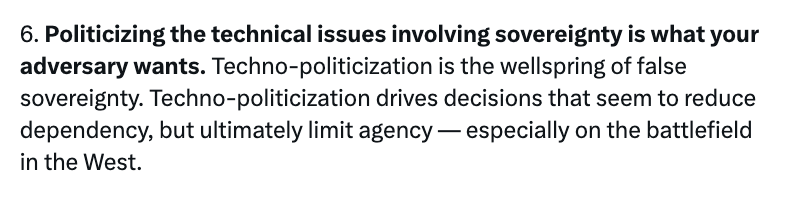
Later in the same post, Palantir says that making “technical decisions based on political preferences” is a “luxury” that the West cannot afford because of the current “existential threat”.
It’s a remarkable argument. One of the world’s most politically embedded technology companies is telling us that deciding who builds critical national infrastructure - is not a political question.
Palantir is trying to persuade the world that there is such a thing as a purely technical decision. There isn’t. Deciding who builds a country’s defence systems, policing infrastructure or public health data platforms - is political. The only question is whose politics are embedded in those systems.
Across Europe, governments are beginning to question their dependence on US technology companies, as covered in last week’s Eye Newsletter. The most recent addition to this chorus of states’ voices was the Spanish government. This week Moncloa reportedly directed companies to avoid new contracts with Palantir.
Don’t let power go unwatched. Max and Charlie will be back in your inbox next week tracking the forces reshaping our democracy.
As digital sovereignty moves from the margins to the centre of policy debates, Silicon Valley has responded by trying to redefine where politics begins and ends and what sovereignty means. If sovereignty no longer means the freedom to choose, but simply to buy the “best” - they are framing Europe’s search for technological independence in a way that can be dismissed.
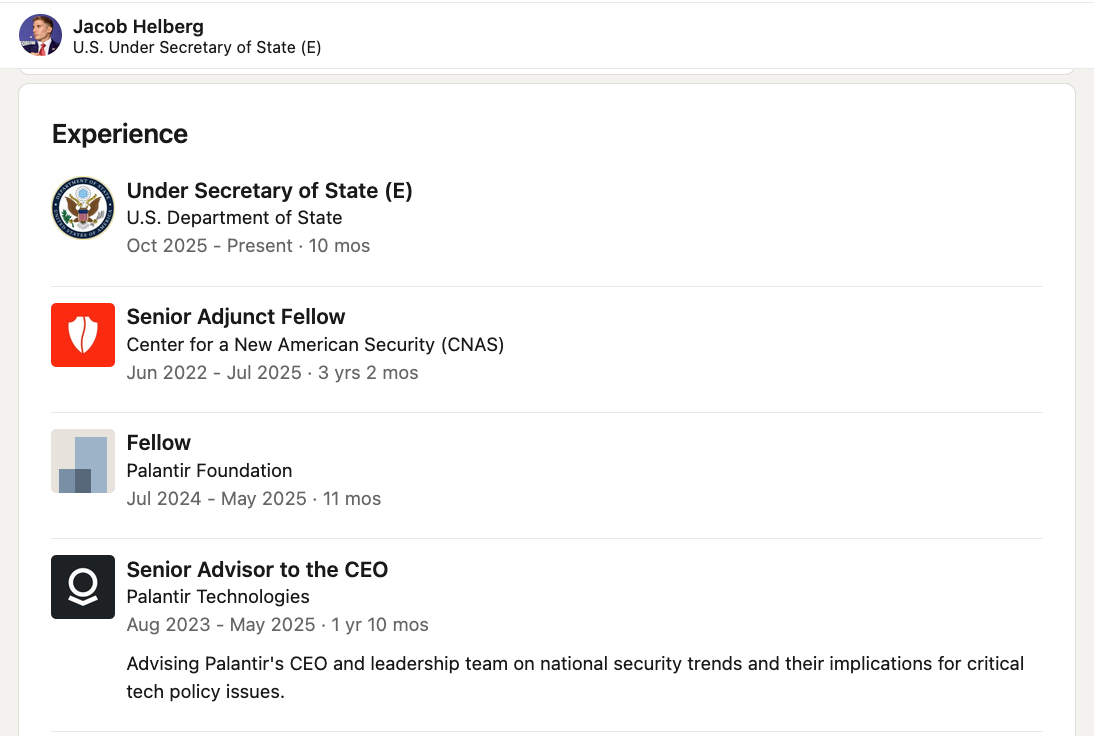
Palantir is not alone. The same day Jacob Helberg - Trump’s Undersecretary of State for Economic Growth, Energy and the Environment, said: “There is a big debate going on internationally… here’s where things get very problematic and insidious. A lot of these supranational organizations like the UN or certain politicians in Europe are trying to usurp “digital sovereignty” to mean that we must rip out all American technology”. Unsurprisingly, Helberg thinks that would be a “catastrophic mistake”.
“What sovereignty really means is being successful, being strong,” he said. If countries reject US technology their destiny is “living in squalor”.
Before Helberg joined Trump’s cabinet, he was a senior adviser to Palantir’s CEO, Alex Karp.
Karp himself struck a similar note in a CNBC interview the next day. “One of the things we’re really trying to get the West to do,” he said, “is moving away from liking or not liking.”
According to Karp, politics has “gone completely nuts” because there is a warped perception that “if things work, it’s evil and bad”. Palantir’s competence and the public’s ignorance, he says, are the reasons Palantir is being attacked. “China doesn’t have that problem… they will win or we will win”.
The imminent threat of global war, commonly described by tech entrepreneurs, is once again invoked to narrow the debate. According to Karp, “it’s binary”. We unquestionably embrace US technological imperialism, or we get taken over by the Chinese. But don’t worry, that’s not a political choice. It’s a technical one.
here is the entirety of Palantir CEO Alex Karp's televised nervous breakdown this morning on CNBC pic.twitter.com/gzD8debrKB
— Aaron Rupar (@atrupar) July 1, 2026
None of this is new. Years ago, Peter Thiel, Palantir’s notorious co-founder, told a libertarian conference that he’d realised “We could never win an election because we’re in such a small minority”. “Maybe,” he added, “you could actually unilaterally change the world without having to constantly convince people and beg people who are never going to agree with you, through technological means”.
The founder of the company now claiming to be apolitical outlined the polar opposite early on, as strategy: “Technology is an incredible alternative to politics.”
In Wednesday’s social media post, Palantir said that other countries “allowing politics or favoritism to determine your technical decisions rewards whoever is best at politics, not whoever is right. Listen to those closest to the problems, not those speaking most compellingly about them”.
As “compelling” as their argument may seem, it rests on a sleight of hand. Who determines what is “right”, is a democratic not an engineering question - and what constitutes “favoritism” should be about what constitutes the public interest - and whose interests technology should serve.
In the UK, some of Palantir’s contracts have been won by direct award, without going through a proper tender process, arguably making them the favourites by default.
In terms of what is deemed “right”, doubts have been also raised by experts in multiple fields from our own domestic agencies and from advocacy groups made up of sector-based professionals, about the efficiency of some of their products at achieving the stated contractual goals, a debate which is currently on the cusp of receiving Ministerial scrutiny and is the subject of deep political contention.
One key example being the backlash to Palantir’s Federated Data Platform’s deal, where there is growing pressure on the government to issue a break-clause in the contract.
This is something that, as Technology minister Liz Kendall has referred to as being partly about patient confidentiality, public trust, and reliance on a US supplier. However, it also, as recently reported by The FT, also has to do with the practicality of Palantir’s actual performance in the NHS, where it won out to secure the deal against a UK consortium of companies.
These questions no longer end with procurement - they extend into tax, industrial strategy and democratic accountability. Once we start asking who builds critical infrastructure - the next question must be - who benefits from it - and on what terms? Last week Open Democracy reported that Palantir has harvested millions in UK tax breaks. In 2024 Palantir’s effective tax rate was just 8%, as opposed to the usual 25%, despite recording £25.3m in pre-tax profits.
The company preaching about sovereignty appears sovereign to no one but itself.
And it's not just Palantir. More than 70% of global market capitalisation is concentrated in US companies. They very often pay next-to-nothing in corporation tax in the countries they work in, by domiciling in low-tax jurisdictions like Ireland. This is the first time in a long time that the world is starting to complain, so much so that Trump recently threatened to sanction countries that taxed US companies. Sovereignty for me, Trump seems to think, but not for thee, and let the tech companies roam free.
Polling by the Fair Tax Foundation, published last week in The Register, found that 67% of Britons believe that the UK should force Big Tech companies like Meta, Google, Apple, and Amazon to contribute more in digital services tax to increase their overall contribution to the economy. We’ve also had a cross-party group of MPs calling out the UK public sector’s dangerous reliance on software produced by a number of US tech firms, including Microsoft, Amazon, and Palantir.
Their proposed amendment to the Cyber and Security Resilience Bill (CSRB), backed by 20 parliamentarians, calls for a digital security strategy to assess the risks of relying on overseas technology in critical infrastructure.
No wonder Palantir wants to re-engineer the definition of sovereignty.
This week, Britain’s presumed future Prime Minister, Andy Burnham, indicated that he wants to revamp the UK’s AI strategy, moving away from a US-centric model and instead placing the priority on British companies and workers.
The FT reported that his team says that the UK’s cosying up to US tech companies had been considered a “geopolitical failure that hasn’t delivered on its intended aims [and has] also put the Labour government at odds with its voters and the vast majority of the British public”.
Oppenheimer was right. We build first and then we argue later. The trouble is that by the time we start arguing - the technology is already embedded. Deciding who builds our critical infrastructure was never a technical question - it was always a political one.
Thanks for reading! We are developing this as we go, and we want to build it with you. Leave us a comment, tell us what’s working, what’s missing, and what you want to see more of.
See you next time,
Max & Charlie
About The Eye: In an era where Silicon Valley is rewriting the rules of governance and unaccountable tech companies are capturing our public services from the inside out, The Eye exists to follow the power, connect the dots and reveal how technology is reshaping our state.