
The great AI bubble, before the crash
The UK government has awarded a record £1.59bn in AI-related contracts in 2026

Welcome back to The Eye – our weekly guide to the shifting relationship between Big Tech and the state.
This week, as warnings of an AI bubble grow louder, we look at the risks for Britain and beyond - with public contracts, data-centre plans and the UK government’s growth strategy increasingly tied to the industry.
We’ll cover: Global debt-fuelled AI investment, dramatic stock sell-offs and the UK government’s record spending spree.
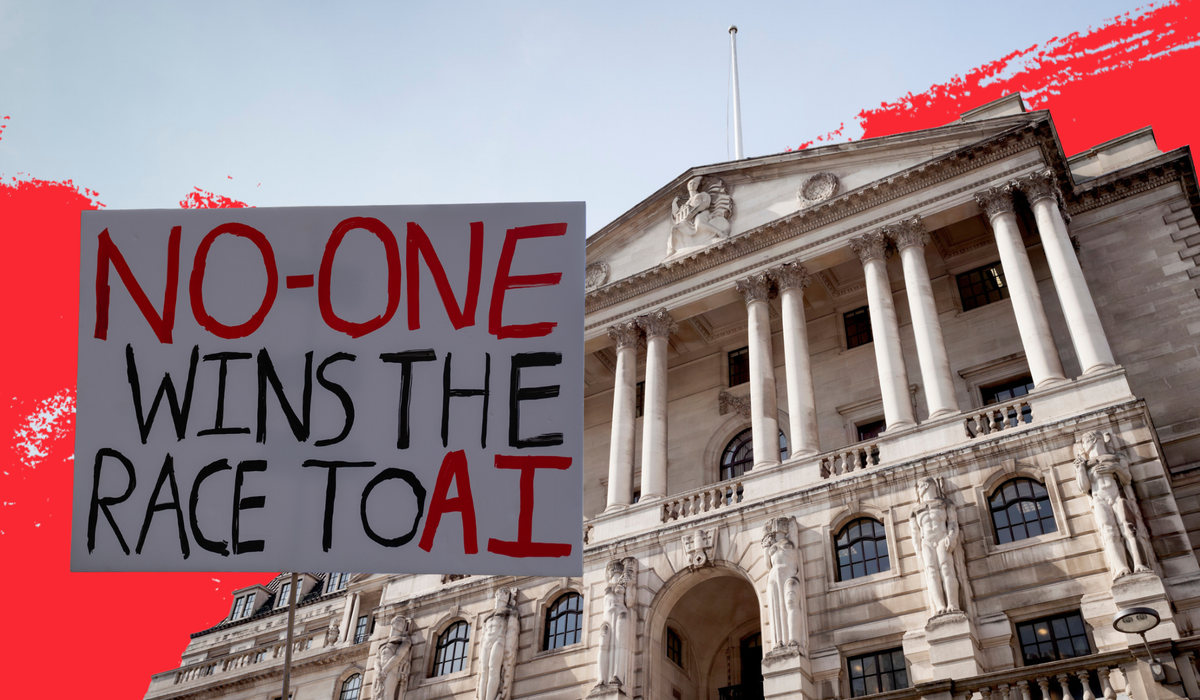
Critics with knowledge of the markets are warning that the AI bubble is set to burst, after a week of particularly intense industry stock selloffs and a year of market volatility. This could expose the countries that have tethered their growth to the AI industry to serious damage, with experts warning of potential recessions which would throw millions of working people into financial hardship.
Prime Minister Andy Burnham has indicated previously that AI would be “key to economic growth”, and forecasts from the International Monetary Fund indicate that the industry is driving economic growth in Britain.
However, last week, former Chairman of the US Securities and Exchange Commission (SEC) Gary Gensler warned that the AI boom is “already a bubble” which could burst before the 2028 US election, triggering a recession, stating that “The question is whether the recession will be mild or something more serious”. Gensler pointed to the vast quantities of money, estimated to be as much as $800 billion a year, being shovelled into industry-related infrastructure.
The same week, Michael Pearce, chief US economist at Oxford economics, stated that the “seeds of the next recession are being sown”, in a note titled “Icarus is flying towards the sun”.
The European Central Bank (ECB) warns that global debt-fuelled AI investment has “historic parallels” with the sub-prime mortgage bubble which led to the 2008 financial crisis, with companies accruing trillions of dollars in off-balance-sheet commitments, in addition to the raising levels of debt.
One vulnerability is the level of debt being used to finance the obscene levels of spending on AI, with Goldman Sachs estimating $500 billion of such debt in 2026 so far, and a further $420 billion to be loaned in 2027.
Michael Burry, who predicted the sub-prime disaster, has been shorting AI stock and predicting a crash in 2027, has likened AI volatility to the 1929 and 2000s market crashes, singling out Nvidia specifically. In a recent X post, he told people “I tried to warn you all”, and that he had “provided the information one would need to sell”.
The comments from experts follow a week which saw a dramatic AI stock sell-off, wiping trillions of dollars from the Nasdaq Composite, erasing its gains for 2026 and leaving it 5% below its level on 1 January. Anthropic fell 9% on its second day of trading, while SanDisk and Nvidia each dropped 14%.
Nvidia then surged 32% after Trump said he had persuaded the board to reinstate Jensen Huang as CEO, adding more than $1 trillion to the company’s value. Based on Trump’s financial disclosures, his Nvidia holdings rose in value by as much as $15 million. But the rally quickly reversed: on Tuesday, Nvidia fell 7.7%, giving back around a third of Monday’s gains, while Anthropic dropped below its IPO price.
‘The building is on fire’
After the Democrats wiped the republican party out in the US midterms, with many signalling plans to halt or regulate data-centre buildout, shares in AI hyperscalers, neoclouds, and data centre developers have taken a huge hit. The stock sell-offs have been described as ‘carnage’ by leading financial publications, with fund managers warning that it is no longer a matter of if the AI bubble will burst, but when.
One manager, who wrote as recently as January that ‘we are not in an AI bubble’, now says ‘today, I would no longer write those words’. Another has stated that ‘the current bubble has run its course. It has been a great ride, but the building is on fire, save yourselves’.
A crash would be catastrophic for those with industry stock tied into their pension providers, or cash held in stocks and shares ISAs, which are heavily weighted towards US stock giants. The Bank of England has warned that a US stock crash could cut UK GDP by 2.2%. The BoE has also warned that the growing indebtedness of AI firms and their opaque and “circular” funding could pose a risk to the UK’s financial stability if they are unable to deliver.
While much of the UK’s AI sector is private, Tussell’s public procurement tracker between January 2018 and October 2026 shows that 2,224 AI contracts worth £5.2 billion have been awarded during that time. £1.59 billion of this was in 2026 alone, more than any previous year.
Of the top ten firms in receipt of public sector AI-related contracts, four are UK-based, four are US-based, and two are German. The top two are American firms Microsoft and Palantir. In the US, 65% of GDP growth was through AI spending from the fourth quarter of 2025 to the third quarter of 2026, leaving them massively exposed, with one Japanese bank warning of a one-in-five chance the US will go into recession in the next 12-18 months.
As the UK government goes ahead with plans to increasingly invest in the industry this could also lead to the possibility of datacentre overbuild, especially in the face of a speculative bubble, meaning more could be constructed than needed to satisfy future global demand.
Britain is not simply exposed to a downturn in global markets: public contracts and data-centre plans are increasingly tied to continued AI expansion. The government should explain what happens to those commitments if the expected demand and returns fail to materialise.
About The Eye: In an era where Silicon Valley is rewriting the rules of governance and unaccountable tech companies are capturing our public services from the inside out, The Eye exists to follow the power, connect the dots and reveal how technology is reshaping our state.