Palantir's capture of Britain's military
How does a foreign tech giant capture UK defence without the public noticing? You bypass competition entirely, and hire the very people writing the rules.


In August last year, Barnaby Kistruck left his role as the Ministry of Defence’s (MoD) Director of Industrial Strategy. He had spent his final months helping to write the UK’s blueprint for military AI, a strategy that advocated for a massively expanded role for AI in British defence.
Exactly nine days later after his departure, he was on the payroll of Palantir - the very US surveillance giant that would land a staggering £240.6 million uncompetitive military contract just three months later.
In this edition of the Citizens Understand, we look inside the Ministry of Defence to reveal how a shameless revolving door paved the way for massive, unadvertised contracts. We break down how these secret processes trapped the MoD in a monopoly, and why Britain’s digital sovereignty hangs by a thread.
The Citizens is a reader-supported newsletter. To support our work, consider becoming a free or paid subscriber.
⏳ The MoD-to-Palantir Pipeline
In 2018, Palantir held an MoD contract worth £28 million. By December last year, that figure had ballooned to a staggering £240.6 million. This progression happened fast, it was expensive, and entirely without competition.
Investigations by openDemocracy and The Nerve have pulled back the curtain on Palantir’s hiring strategy, exposing a shameless revolving door between Whitehall and Silicon Valley. How did we get here?
A timeline
2018: Palantir secured its first major £28m contract with the MoD by targeting specific, high-pressure administrative crises. While the military struggled to stem the tide of personnel leaving the Royal Navy, Palantir swooped in with its data-integration software, Foundry, promising to clean up the mess.
November 2022: Palantir is awarded a three-year MoD contract worth £75.2 million. The tender was not advertised, and there was no competition.
The MoD justified sidestepping standard competitive requirements by claiming its data capabilities rely on architecture that “only Palantir is able [to] licence, and which only Palantir has the design familiarity and technical expertise to fully support”.
Because the MoD did not publish the underlying technical requirements, it is impossible to verify from public records whether any other global supplier could have fulfilled the contract.
February 2025: Prime Minister Keir Starmer took an “informal” visit to Palantir’s Washington headquarters to meet CEO Alex Karp. The meeting was arranged by Britain’s US Ambassador, Peter Mandelson, whose lobbying firm—Global Counsel—counted Palantir as a major client.
That same year, Palantir held official meetings with six cabinet ministers and senior officials across the Cabinet Office, the Treasury and the Home Office.
August 2025: Barnaby Kistruck resigned from the MoD, ending a two-decade civil service career.
September 2025: Kistruck starts his new job as Senior Counsellor at Palantir. He was the company’s fourth major hire from the public defence sector in 2025, alongside senior civil servants Laurence Lee and Damian Parmenter, and former Conservative armed forces minister Leo Docherty.
These names are part of a wider ‘revolving door’ that has seen Palantir recruit over 30 UK government and public sector officials.
December 2025: Exactly three months after Kistruck’s appointment, Palantir was handed a massive follow-on three-year MoD contract worth £240.6 million - more than triple the value of the 2022 deal. Once again, it was a direct award bypassed without competition.
The contract aims to “modernise defence” by providing data analytics capabilities supporting strategic, tactical and live operational decision-making across all military security classifications.
🌀 The illusion of sovereignty
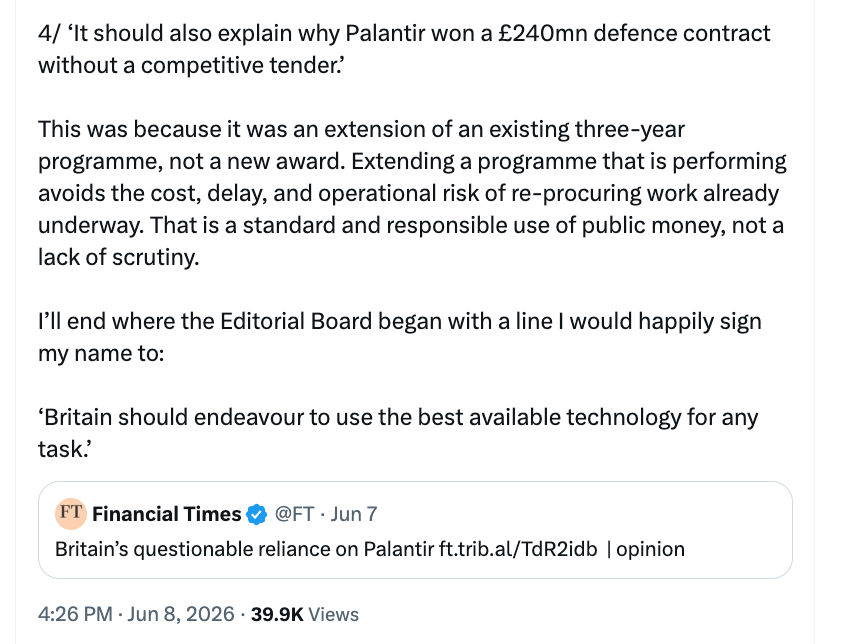
This week, following an editorial by the FT calling on government to “explain why Palantir won a £240m defence contract without a competitive tender,” Palantir’s UK chief executive, Louis Mosley—grandson of the notorious 1930s British fascist leader Oswald Mosley—took to X to defend the multi-million-pound payout.
Mosley deflected criticism by framing the uncompetitive deal as an administrative necessity, arguing that extending the existing contract avoids the “cost, delay, and operational risk” of a new bidding process.
While Mosley manages the commercial narrative, the government relies on the blanket assurance that “all data remains sovereign and under the ownership of the MoD”.
But MoD insiders working directly with these systems reached out to The Nerve in March this year to expose these official assurances as a dangerous delusion. While the raw data may legally be under government control, the insights generated from it are not. Palantir does not need to own the data to exploit it.
With over £670 million in contracts spanning the NHS, the Home Office and the MoD, Palantir’s architecture continuously extracts and aggregates the underlying metadata across multiple departments. By cross-referencing health records, immigration status, and military data, the software automatically synthesises insights and behavioural profiles that the government itself lacks the capability to generate.
As one MoD source said, this sweeping integration means a single foreign corporate giant now effectively holds “a complete profile on the whole UK population”.
🔎 Our take: a commercial surrender
Palantir’s dominance relies on a two-pronged strategy of revolving door recruitment and technical lock-in. As Susan Hawley of Spotlight on Corruption points out,”There is no doubt that companies do this to get privileged insights into how the government runs and gain commercial advantage”. The result is a proprietary trap.
The Swiss army flatly rejected Palantir over fears that sensitive operational data could be accessed by US intelligence services, a security flaw exposed by the independent Swiss magazine Republik.
Instead of addressing these flaws, Palantir tried to silence the press with a lawsuit that backfired spectacularly, with the court rejecting 22 out of Palantir’s 23 claims and handing the magazine a historic 95% victory.
Why couldn’t the same standard of resistance be found in the UK? By treating Palantir as indispensable to how our military fights, plans and thinks, the government has engineered its own subservience to a single foreign corporate actor. Palantir is no longer a standard, arms-length service provider; it is an unaccountable, single point of failure embedded at the core of the state.
📢 How to fight back
We are launching a major campaign to challenge this and establish a fundamental principle: critical digital infrastructure must be governable by democratic society, not by states or corporations acting without accountability.
But we cannot build this movement without you.
To follow our efforts, receive updates on how you can take action, and stay connected with our media and toolkits, subscribe today.
See you next time,
Team Citizens
About The Citizens Understand: In an era where technology is reshaping democracy faster than laws can keep up and power is increasingly exercised through platforms, Citizens Understand exists to cut through misinformation and make complex systems legible. If there’s something you’d like to understand, email lillian@the-citizens.com.